

Walk into any gym in America and you’ll see the same scene play out: someone performing the same exercises with the same weights for the same reps—month after month, year after year. Then they wonder why they look exactly the same as they did twelve months ago.
The missing ingredient isn’t more protein powder, a fancier training split, or the latest supplement stack. It’s a fundamental principle that governs all physiological adaptation: progressive overload. Without it, your body has zero reason to change. With it, strength gains become not just possible but inevitable.
Whether you’re a beginner picking up your first barbell or a seasoned lifter hitting a stubborn plateau, understanding how to systematically challenge your body is the difference between spinning your wheels and making measurable progress. Here’s what the science says about why progressive overload works—and exactly how to implement it without burning out or getting injured.
What Is Progressive Overload? (And Why Your Muscles Demand It)
Progressive overload is the gradual increase of stress placed upon the body during exercise training. At its core, it’s the principle that to get stronger, build muscle, or improve endurance, you must continually challenge your body beyond its current capacity.
The concept dates back to ancient Greece, where wrestler Milo of Croton reportedly carried a calf on his shoulders every day. As the calf grew into a bull, Milo’s strength grew proportionally—an early demonstration of progressive loading in action. While the story is likely apocryphal, the physiology is sound.
Here’s what actually happens when you lift weights: you create microscopic damage to muscle fibers and deplete energy stores. During recovery, your body doesn’t just repair that damage—it overcompensates, building back slightly stronger than before to handle future stress. This process, called supercompensation, is the engine of all physical improvement.
However, adaptation is specific. Your body only changes in response to the demands placed upon it. If you squat 135 pounds for 10 reps every week, your body maintains exactly enough muscle and neural efficiency to squat 135 for 10—no more, no less. Research published in the Journal of Strength and Conditioning Research confirms that without progressive increases in training stimulus, athletes reach a plateau within 8-12 weeks, regardless of their training volume.
The Science Behind Progressive Overload and Muscle Growth
To understand why progressive overload is non-negotiable, you need to know what drives hypertrophy (muscle growth) and strength gains at the cellular level.
Mechanical Tension: The Primary Driver
Mechanical tension—the force generated within muscle fibers when they contract against resistance—is widely considered the most important factor for muscle growth. Studies from McMaster University demonstrate that mechanical tension activates anabolic signaling pathways (particularly mTOR) that trigger protein synthesis. When you lift heavier weights or perform more reps with the same weight, you increase this tension, forcing your muscles to adapt by growing larger and stronger.
Metabolic Stress and Muscle Damage
While mechanical tension reigns supreme, metabolic stress (the “burn” from accumulated metabolites like lactate) and muscle damage also contribute to growth. Research in Sports Medicine indicates that these mechanisms become increasingly important as you advance, particularly when you manipulate training variables beyond just adding weight—such as increasing time under tension or decreasing rest periods.
A 2020 meta-analysis examining 192 studies found that training with progressive overload principles resulted in significantly greater strength gains (roughly 30-40% over 12 weeks) compared to non-progressive training, regardless of the specific loading scheme used. The key wasn’t the specific program—it was the consistent application of increasing challenge.
5 Ways to Apply Progressive Overload (Beyond Just Adding Weight)
Most people think progressive overload simply means “add five pounds to the bar.” While that’s the most straightforward method, it’s not the only one—and eventually, it’s not sustainable. You can’t add 5 pounds to your bench press forever. Here are the scientifically-validated methods to keep progressing:
1. Increase the Weight
The classic approach. If you squatted 185 pounds for 3 sets of 8 reps last week, aim for 190 pounds for the same reps this week. For upper body exercises, smaller jumps (2.5-5 pounds) work better; lower body movements can typically handle 5-10 pound increases.

2. Increase the Repetitions
If adding weight isn’t possible or desirable, add reps. Using our squat example, instead of 185 for 8 reps, perform 185 for 9 or 10 reps. This increases total volume and metabolic stress. This method works particularly well for bodyweight exercises, isolation movements, or when you’re nearing your strength ceiling on a particular lift.
3. Increase Training Volume (Sets)
Adding an extra set is a simple way to increase total work performed. If you’ve been doing 3 sets of bench press, bump it to 4 sets. Research suggests that volume (total sets × reps × weight) is a primary driver of hypertrophy, with higher volumes generally producing greater growth—up to a point of diminishing returns.
4. Improve Exercise Technique and Range of Motion
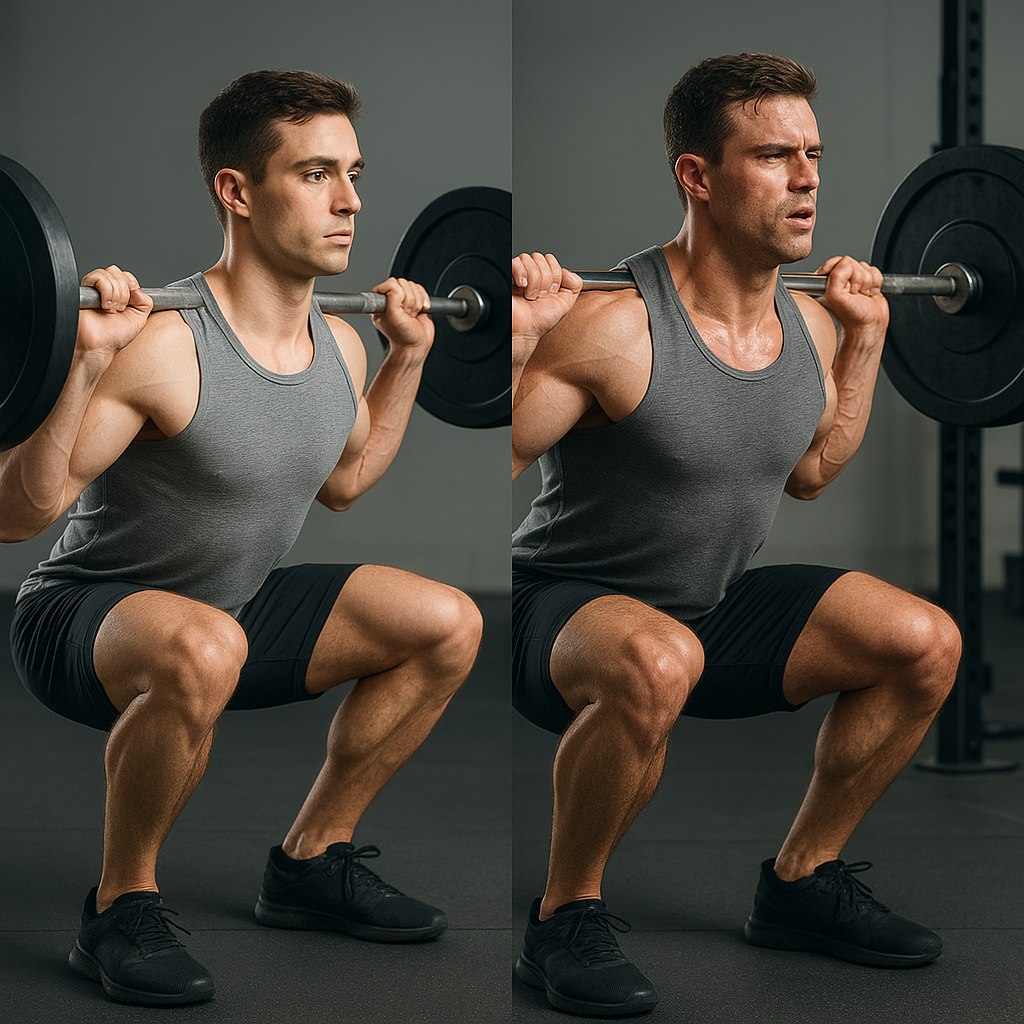
Sometimes “progress” means doing the same weight with better form or through a greater range of motion. If you’ve been doing quarter squats with 225 pounds, progressing to full-depth squats with the same weight represents genuine overload. Similarly, eliminating momentum or pausing at the bottom of a rep increases time under tension, making the same load feel significantly heavier.
5. Manipulate Rest Periods and Density
Performing the same workout in less time increases training density. If you normally rest 3 minutes between sets of deadlifts, try cutting it to 2.5 minutes while maintaining performance. This metabolic stress creates a different adaptive stimulus, improving work capacity and potentially enhancing hypertrophy.
How Fast Should You Progress? The Reality of Rate of Gain
One of the most common questions about progressive overload is how quickly to increase the challenge. The answer depends entirely on your training age—how long you’ve been consistently lifting.
Beginners (0-6 months of training): You can progress almost every workout. The “novice effect” allows for rapid neurological adaptations. Aim for 5-pound jumps on lower body lifts and 2.5-pound increases on upper body movements each session. Linear progression (adding weight every workout) typically works for 3-6 months before stalling.
Intermediate (6 months-2 years): Progress shifts to weekly or bi-weekly increases. You might add 5 pounds every other week, or use a double progression model—working up to a rep target (e.g., 12 reps) before increasing weight and dropping back to 8 reps.
Advanced (2+ years): Progress becomes measured in monthly or even quarterly increments. You might only add 2.5-5 pounds to your squat every 4-6 weeks, or focus on adding reps across several weeks before testing heavier weights.
A 2018 study in the European Journal of Applied Physiology found that subjects who attempted to progress too rapidly (increasing loads by more than 10% weekly) experienced significantly higher rates of overreaching and injury compared to those following a more conservative 2.5-5% weekly increase. The lesson? Consistency over months and years beats aggressive loading over weeks.
Sample Progressive Overload Plan for Beginners
Theory is useless without application. Here’s a simple, science-backed approach to implementing progressive overload if you’re just starting out:
The Double Progression Method
This approach works for any exercise and automatically regulates your progress based on performance:
- Choose a rep range: Pick a range like 8-12 reps for hypertrophy or 4-6 for strength.
- Start at the bottom: Select a weight you can lift for the lower number of reps with good form (e.g., 8 reps).
- Progress within the range: Each workout, try to add one rep per set until you hit the top of the range (12 reps) for all sets.
- Increase weight: Once you hit the top of the range, increase the weight by 2.5-5 pounds and drop back to the bottom of the rep range.
For example, with dumbbell bench press: Week 1 you do 50s for 8, 8, 8. Week 2 you manage 9, 8, 8. Week 3 you hit 10, 9, 9. Continue until you hit 12, 12, 12, then move to 55-pound dumbbells and start over at 8 reps.
Common Progressive Overload Mistakes That Kill Gains
Even when lifters understand the principle, they often sabotage themselves with these errors:
Program Hopping
Progressive overload requires consistency. If you change exercises every two weeks, you never give your body time to adapt to a specific movement pattern. Stick with the same core lifts for at least 6-8 weeks to allow for meaningful progression.
Sacrificing Form for Numbers
Adding 10 pounds to your squat doesn’t count as progress if you cut the depth in half to lift it. True overload requires maintaining technique standards. The weight is just a tool; the stimulus on the muscle is what matters.
Ignoring Recovery
Progressive overload only works if you recover from the stress. Research shows that protein synthesis remains elevated for 48-72 hours post-training, but if you’re not sleeping 7-9 hours or eating adequate protein (0.7-1 gram per pound of bodyweight), you won’t adapt to the increased demands.
When to Deload: The Art of Strategic Regression
Counterintuitively, sometimes the best way to keep progressing is to temporarily back off. Deloading—planned periods of reduced volume or intensity—allows accumulated fatigue to dissipate while maintaining fitness.
Consider a deload every 6-8 weeks, or when you experience:
- Stalled progress for 2+ consecutive workouts
- Persistent joint aches or muscle soreness that doesn’t resolve
- Decreased motivation or disrupted sleep
- Performance drops of 10% or more from your best
During a deload, reduce your working weights by 40-50% or cut your total sets in half while maintaining the same movement patterns. This isn’t wasted time—it’s the recovery period that allows supercompensation to occur, setting you up for the next block of productive training.
Conclusion: The Compound Effect of Consistent Challenge
Progressive overload isn’t sexy. It doesn’t promise six-pack abs in six weeks or a 50-pound strength gain in a month. It simply guarantees that if you consistently ask a little more of your body than you did last time, it will eventually become capable of much more than you ever thought possible.
The principle applies whether you’re a powerlifter chasing a 500-pound deadlift or someone who just wants to carry groceries without back pain. Start with weights that challenge you but allow perfect form, track your workouts in a notebook or app, and aim for small, sustainable improvements—whether that’s one more rep, five more pounds, or better technique with the same load.
Remember Milo and his calf. Strength isn’t built in dramatic leaps but in the accumulation of barely noticeable increases, day after day. The lifter who adds just 2.5 pounds to their bench press every month might seem unremarkable in January, but by December, they’re 30 pounds stronger—and that makes all the difference.